

First Look At The FBI Crime Stats For 2022: I Don’t Even Have To Explain Per Capita

The FBI released its crime report for 2022, and I thought it instructive for us to examine homicide numbers.
Homicides from 1985–2022.
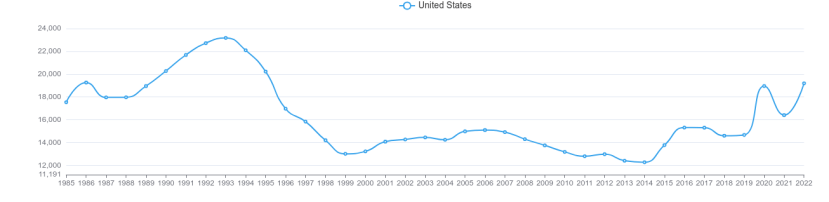
Now it is, or should be, obvious that these are counted homicides. Homicides that are not counted are not on the chart. Do not forget that millions of people have entered the country illegally, and counts for these people, on a range of behaviors including crime, do not exist or are incomplete.
I say “illegally” but while these people break the laws on the books when the sneak into the country, their entry is also tacitly encouraged by rulers. And the real laws are those which are enforced by rulers, not what are on the books.
Anyway.
Many account for the mid 90s bump—when, do not forget, there were fewer people in the country: 260 million to 333 million or so since then—to the so-called crack epidemic. Prosperity, they say, accounts for the long period of quiet, until prosperity for the masses left.
The George Floyd hoax gave us the 2020 bump. The covid panic the decrease. The fading of the panic brought us back to Floyd levels.
Race:
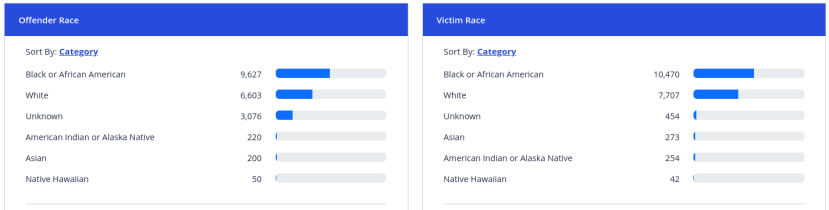
Because of the people who broke the law entering the country, it’s difficult to put the exact percentage of each race. Estimates put blacks between 12-13% of the population. In 2022, the Census put Whites (including Hispanic Whites) at about 76%, with non-Hispanic Whites at just over 59%. The FBI doesn’t give enough information to separate Hispanics from overall Whites.
Asians are about 7%. American Indian or Alaska Native are about 2.6%. Native Hawaiians are around 0.4%. These don’t all add to 100%, so there is some error in measurement.
Put blacks at 12.5%, and all Whites (including Hispanics) at 75%, understanding there is some plus-or-minus. In 2022, about 333,300,000 people were in the USA; again, plus or minus.
Blacks were known homicide offenders 9,627 times, and Whites 6,603 times. Blacks, then, had a homicide rate of 23.1 per 100,000 (of blacks). And White had a homicide rate of 2.6 per 100,000 (of Whites, including Hispanics). Which means blacks are at least 8.7 times more homicidal than Whites. Plus or minus.
The “at least” is because of the 3,076 homicides where the race of the offender was unknown. Now if these were distributed the same as the known offenders, then there is no change in the rates or relative rate. But if, as one suspects, blacks are involved disproportionately, then the rates do change.
If all 3,076 unknowns were ascribed to blacks, then their rate is 30.4 per 100,000, with an increased relative rate compared to Whites of 11.5. That forms an upper bound, which itself is unlikely. But it is correct to say the black rate is from 23.1 to 30.4 per 100,000. Plus or minus.
There were 19,766 offenders with reported race. If, somehow, blacks formed their own nation, and their numbers were removed from the USA, the non-black USA would have a homicide rate of 2.4 to 3.5 per 100,000, depending if we ascribe none of the 3,076 unknowns to where we ascribe all to non-black USA, with the number more likely being on the lower end. And, of course, the black rate would be 23.1 to 30.4. Ten times higher. Roughly, plus or minus.
Canada’s rate overall for contrast is about 2.1. Again, it is unknown what the rate is for non-Hispanic Whites alone, but one suspects it is comparable, or even smaller, than Canada’s.
Overall, there were 19,766 homicide offenders, which makes blacks anywhere from 48.7% to 64.2% of the total. Blacks therefore comprised about half to possibly three fifths of all homicide offenders. This means I don’t even have to explain “per capita”.
We hear a lot about “gun control”, which implies the sentiment that only Regime employees should control guns (like the IRS, DNR, and so forth). Firearms were used in 13,643 of 19,200 homicides where the type of weapon was known. We don’t have the racial breakdown of weapon use. But if we assume it is proportional, each race preferring firearms equally, then blacks used firearms from 6,641 to 8,762 times, with the rest used mostly to Whites.
Blacks, as is clear, also suffer the highest rates of being killed, also far out of proportion to their population rates. Black victims had a rate of about 25.1 per 100,000, with Whites (including Hispanics) about 3.1 per 100,000. The ratio is similar to the offender rate, meaning blacks are about 8.2 times more likely to be murdered than Whites.
Beside the plus-or-minus, there is some year-to-year variation in these numbers, like the riot of murders set off by Black Larcenous Marauders in the Floyd hoax. But these variations are relatively minor and never approach equality. Blacks are always about ten times more homicidal than Whites.
The crime problem which is so evident, then, is a black problem. There does not seem to be any acceptable solution, either.
Subscribe or donate to support this site and its wholly independent host using credit card click here. Or use the paid subscription at Substack. Cash App: $WilliamMBriggs. For Zelle, use my email: matt@wmbriggs.com, and please include yours so I know who to thank.
Necessary correction from Greg Kent, over at the blog:
Briggs, when you created your graph from the FBI CDE’s Expanded Homicide data, you should have notice a disclaimer: “2021 Expanded Homicide Data includes fewer homicides due to an overall decrease in participation from agencies that are not yet reporting via NIBRS.” It turns out the FBI data source changed right in the midst of the BLM effect. The new data source significantly understates the nationwide estimates for 2021 and after in the Expanded Homicide data. The 2021 data covered only about 65% of the population and the 2022 data bout 77% of the population, down from 90%+ in 2020. Therefore, the “Expanded homicide” data you pulled from the Crime Data Explorer is significantly understated in 2021 and 2022. A more accurate nationwide estimate is available via the “NIBRS Estimate” page at https://cde.ucr.cjis.gov/LATEST/webapp/#/pages/explorer/crime/nibrs-estimates. The complete data shows 23061 and 21593 murder offenses in 2021 and 2022, respectively, rather than the 16413 and 19200 numbers from the incomplete data source. The difference between the data sources for 2021 has been significant in the political debate about the impact of the 2020 BLM protests. The FBI’s “Expanded Data” (which is the incomplete data source that your plot used) appears to show 2020 as a one time bump that 13% fell back to normal levels in 2021. Unfortunately, the apparent drop in murders in 2021 was purely an artifact of the incomplete dataset. Reality was otherwise. The FBI’s complete data shows that murder offenses increased in 2021 by 22% on top of the 29% increase that occurred in 2020. This result is intuitive. After all, there was a nationwide lockdown in the spring of 2020 and the BLM protests didn’t start until the middle of the year. There was a slight 6% decrease in murders in 2022, as the FBI’s press release reports, but that is rather small and is far from recovering from the huge increases the previous two years. Overall, the FBI’s complete data shows that the rise in murders since the 2020 police pullback has persisted. The three year average for black murder victims has increased 56% (from 7781 for 2017-19 and 12138 for 2020-22), which shows that black lives have not faired very well in this BLM era. It is regrettable that the FBI’s data change has made this reality hard to see. Apparently even for eminent statisticians.
https://www.wmbriggs.com/post/49120/#comment-217077
Great exposition of the current state of crime in America.
But that final throw-away line is sort of a downer:
"There does not seem to be any acceptable solution, either."
Potential solutions abound! Think positive!
If it's acceptable to propose "reparation" payments to Americans with a drop of African blood in their veins, then it's also acceptable to propose other solutions for dealing with the same population. Remember Liberia! Lots of land in Africa just waiting for industrious, oppressed Africans to build Wakanda!
On a related note, essays comparing America statistics (crime, life expectancy, health, income inequality, etc) to European, or Asian countries--casting America in an unfavorable light--always ignore demographic realities. Extract blacks from life expectancy stats, or health stats, or crime stats, and America is on a par with other advanced countries. And, conversely, American blacks are about the same as their brethren in Africa. The murder rate in Nigeria is 21/100,000 about the same as black America.